AI with a Human Face: Why Bharat’s Farms Need Human-in-the-Loop Intelligence
Fully automated AI is a liability where the stakes are a family’s livelihood and trust is thin. In Indian agriculture, the human in the loop is not a limitation. It is the design.
By Dr. Nandini Rao · Contributing Writer, AI & Agronomy
Picture a moment familiar to anyone deploying AI in the field. A model studies satellite and photo evidence and flags a likely fungal outbreak across a cluster of soybean plots. An experienced agronomist reviews the same images and recognises something subtler: waterlogging from a broken field channel — a problem for a spade, not a fungicide. The farmer is best served by both: the model’s tireless reach and the human’s discerning eye. That partnership is the whole argument of this article.
There is a version of agricultural AI that promises to remove the human entirely: an autonomous system that ingests data and issues decisions at scale. It is an appealing story for a deck and a dangerous one in the field. Where a wrong answer can cost a family its season, and where trust in institutions is already fragile, full automation is not an achievement to aspire to. It is a risk to design against — and designing against it is how AI earns its place in Bharat.
The autonomy trap
The appeal of full automation is scale — a system that decides without humans can, in theory, serve millions at near-zero marginal cost. But that logic ignores what the decisions carry. An advisory that is confidently wrong about a pest, a crop choice, or an input dose does not merely disappoint; it can destroy a smallholder’s income for the year. Unlike a consumer recommendation that can be shrugged off, a farming decision is often irreversible within the season.
The autonomy trap is the assumption that because a system can decide alone, it should. In high-stakes, low-trust settings, that assumption inverts. The cost of a rare bad automated decision, multiplied across a vulnerable population, can outweigh the efficiency gains many times over — and each such failure erodes the trust the whole system depends on.
Where AI helps, and where humans must stay — a practical division of labour
The right design does not reject AI; it places it precisely. AI is exceptionally good at the tasks that overwhelm human capacity: reading each farmer’s verified profile against the vast space of central and state schemes; drafting a bankable loan file or a subsidy application; translating advisory into the farmer’s own language and dialect at scale; spotting a pest outbreak pattern across a district before any individual officer could. These are the tasks where automation genuinely multiplies reach — the equivalent of giving every farmer a tireless, multilingual assistant.
What AI should not do alone is render the final high-stakes judgement without a human able to check it. In practice, Gramraj draws the line by consequence: a low-stakes reminder about an enrolment window flows straight through; a recommendation that would change what a family sows, borrows, or sprays is reviewable by a trained agronomist or field partner before it lands; a case where the model is uncertain, or the situation unusual, is routed to human judgement rather than forced into a machine answer. The intelligence layer proposes; a person, where the stakes warrant, disposes. The machine handles breadth; the human guards against the confident error the machine cannot recognise in itself.
Designing the loop
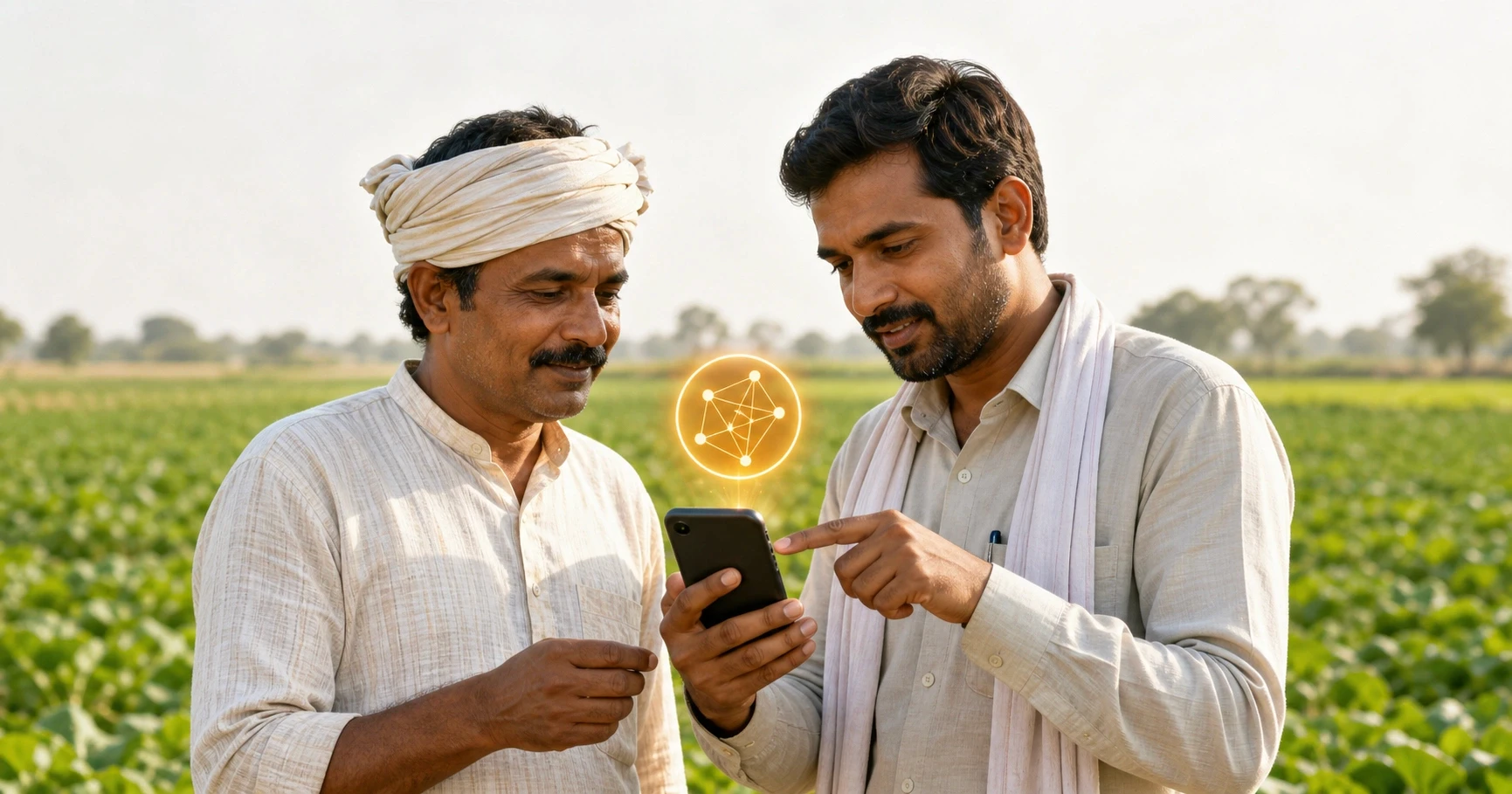
Keeping a human in the loop is an architectural decision, not a disclaimer. It means recommendations are reviewable by construction; escalation from machine to human is smooth rather than exceptional; and the people in the loop — agronomists, FPO coordinators, field partners — are equipped and trained, creating skilled rural employment rather than replacing it. Done well, the loop is invisible to the farmer and load-bearing for the system. She experiences a service that is fast, fluent, and available in her language — and behind it, the assurance that a person stands where a person needs to.
Accountability, and trust as a design constraint
The human in the loop also solves a problem pure automation cannot: accountability. When a recommendation can be explained and, where needed, stood behind by a person, the system becomes answerable in a way a black box never is. A decision no one can explain is a decision no farmer should have to accept.
The deepest reason to keep the loop is trust itself. In a context where farmers have been failed before, the loop is what makes the system credible — proof that the platform is built to serve, not merely to scale. Gramraj treats human-in-the-loop AI as a defining principle, not a transitional stage on the way to full autonomy. This is what AI for Bharat should mean: world-class intelligence, with an Indian face the farmer can question, in a language she speaks, accountable to her. The goal is not the most automated system. It is the most trusted one.