Made in India, Ready for the World: Exporting the Farmer OS to the Global South

The problems India’s smallholders face are the problems of the Global South. Solve them at India’s scale, and the architecture is built to export — the next chapter in India’s DPI leadership of the developing world.
By Arvind Krishnan · Contributing Writer, Public Infrastructure
Whenever this architecture is shared with friends from the Global South, the response follows a pattern: change the scheme names and the languages, and you have described our country too. It is a humbling observation, and an inspiring one — because it means that what India solves for its own farmers, it solves, in large measure, for the farming world. That is the spirit in which this article is written.
It is tempting to treat a solution built for Indian agriculture as a purely Indian story. That undersells it — and undersells India. The defining features of the Indian farmer’s predicament — fragmented services, thin trust, weak market access, language and literacy barriers, coordination that no one owns — are the defining features of smallholder agriculture across much of the world. An operating layer that solves them here is not a local product. It is a template with a very large addressable map, and India is uniquely positioned to be its author.
The shared problem
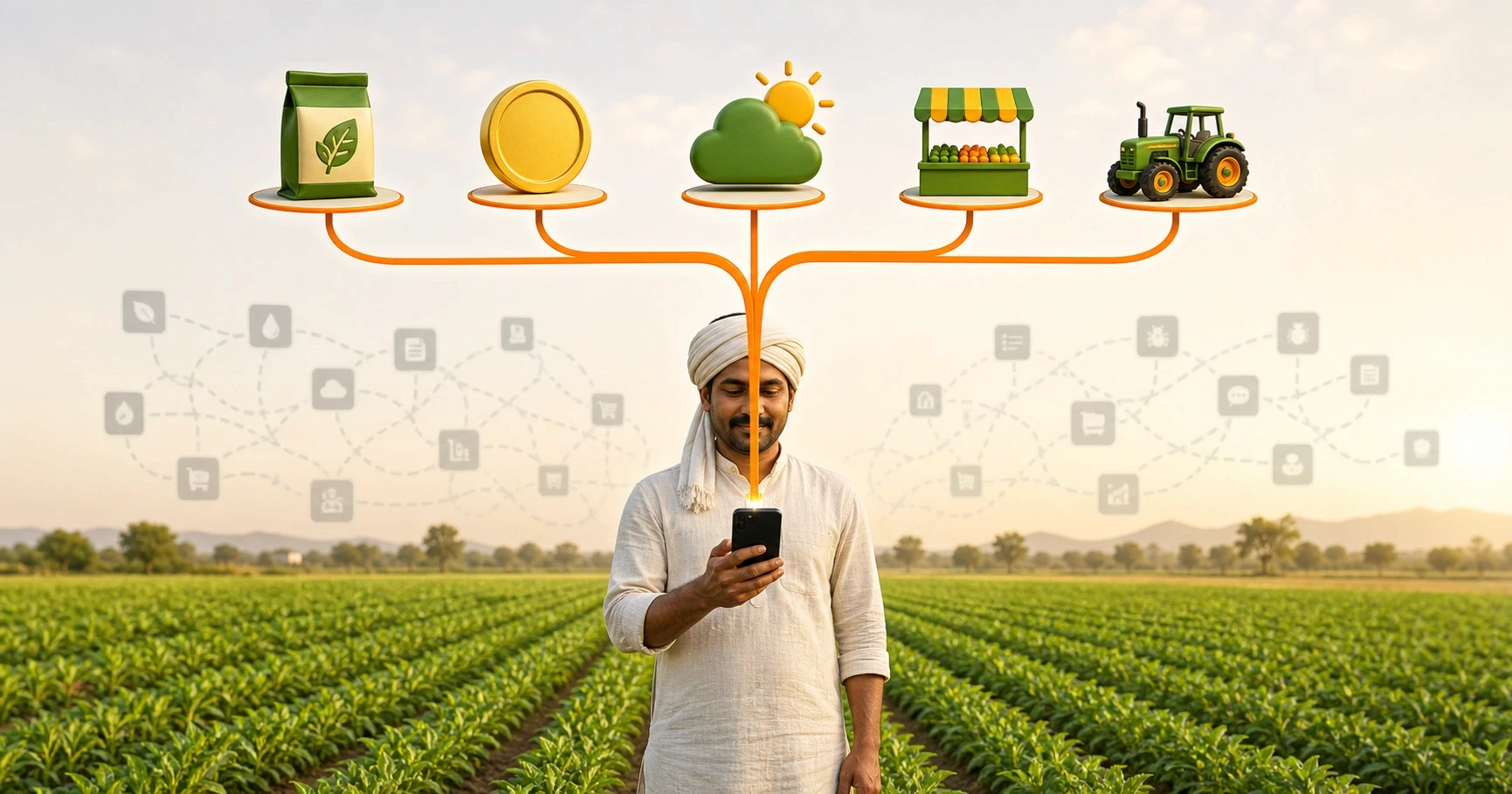
The numbers describe how widely this experience is shared. By FAO’s research, five of every six farms in the world are smaller than two hectares; smallholder farms produce roughly a third of the world’s food and support the livelihoods of some two billion people. Across Africa, South and Southeast Asia, and Latin America, these farmers face conditions immediately recognisable to an Indian smallholder: too many disconnected services, too little trusted information, credit that does not reach them, markets that capture more of the value than they should. The specifics differ — crops, schemes, institutions — but the structural problem is the same. It is a coordination problem, and coordination problems have portable solutions.
Why India is the hardest proving ground
If the architecture works in India, the case that it works elsewhere is strong — because India is close to the hardest version of the problem. It combines vast scale, extreme diversity of language, crop, and geography, a complex layering of central and state systems, and a population spanning every level of digital literacy. A system that can coordinate services for the Indian farmer has been tested against more variety and difficulty than most other markets will ever present.
This inverts the usual export logic, in which a product built for a simpler market struggles to scale up. Here, the product is forged in the more demanding environment first. Proving the model on the world’s largest and most diverse farmer base is what makes it credible everywhere else. “Made in India” is, in this category, the strongest quality mark available.
What travels and what localises
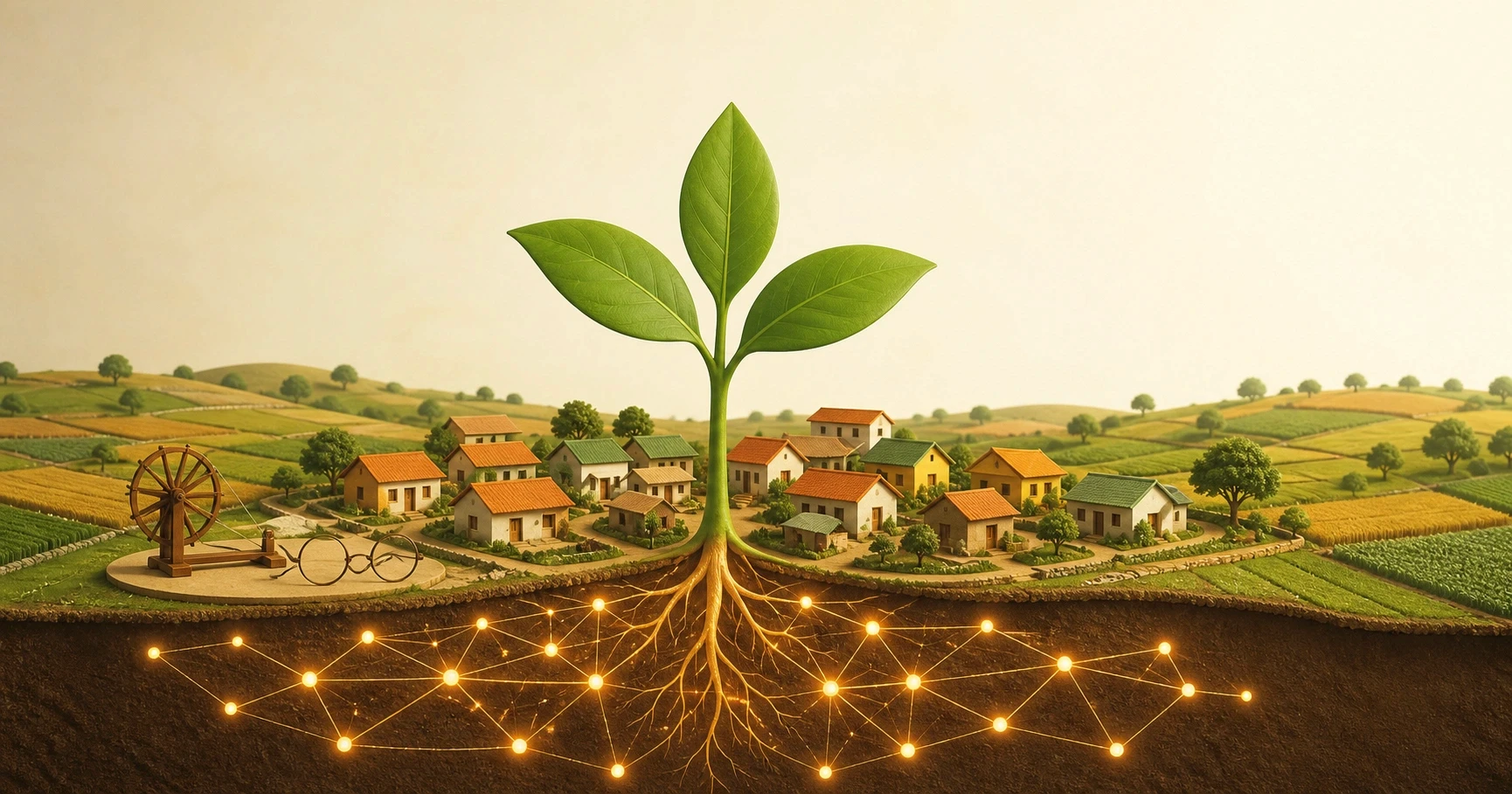
Exporting the model does not mean copying it wholesale. The architecture separates cleanly. What travels is the operating layer itself: the four-layer structure, the intelligence that matches farmers to services, the consent and trust framework, the coordination logic. What localises is the content plugged into it — local schemes replacing PM-KISAN and PMFBY, local languages replacing Hindi and Marathi, local banks and mobile-money systems replacing India’s rails, local registries where AgriStack sits at home. Build the architecture once, adapt the local layer, and it repeats.
The DPI export story
There is a ready-made pathway for this ambition, and India built it. India’s digital public infrastructure has already become one of its most admired exports — a model showcased to the world during India’s G20 presidency and now studied and adopted by nations across the Global South, with India actively offering its stack to partner countries. A farmer operating layer, proven on Indian rails at Indian scale, extends that story into agriculture — a sector of first-order importance across the developing world. India has been generous in sharing its digital public goods with partner nations, in the spirit of Vasudhaiva Kutumbakam — and agriculture is a natural, meaningful extension of that generosity.
A template for smallholder economies
The prize, stated plainly, is a replicable architecture for smallholder economies everywhere — coordination, trust, and access for the hundreds of millions of farmers who share the Indian smallholder’s predicament. Gramraj is built for Bharat first, without apology, because Bharat is where the problem is hardest and the impact largest. But it is designed from the outset to travel, because the problem it solves does not stop at the border.