One Farmer, One Journey: Why Bharat’s Annadata Needs an Operating System, Not a Thirteenth App

India has built more agricultural technology in the last decade than in the fifty years before it — and the farmer’s experience is still broken. The problem was never a shortage of apps. It was the absence of an operating system.
By Devika Menon · Contributing Writer, Technology & Rural Development
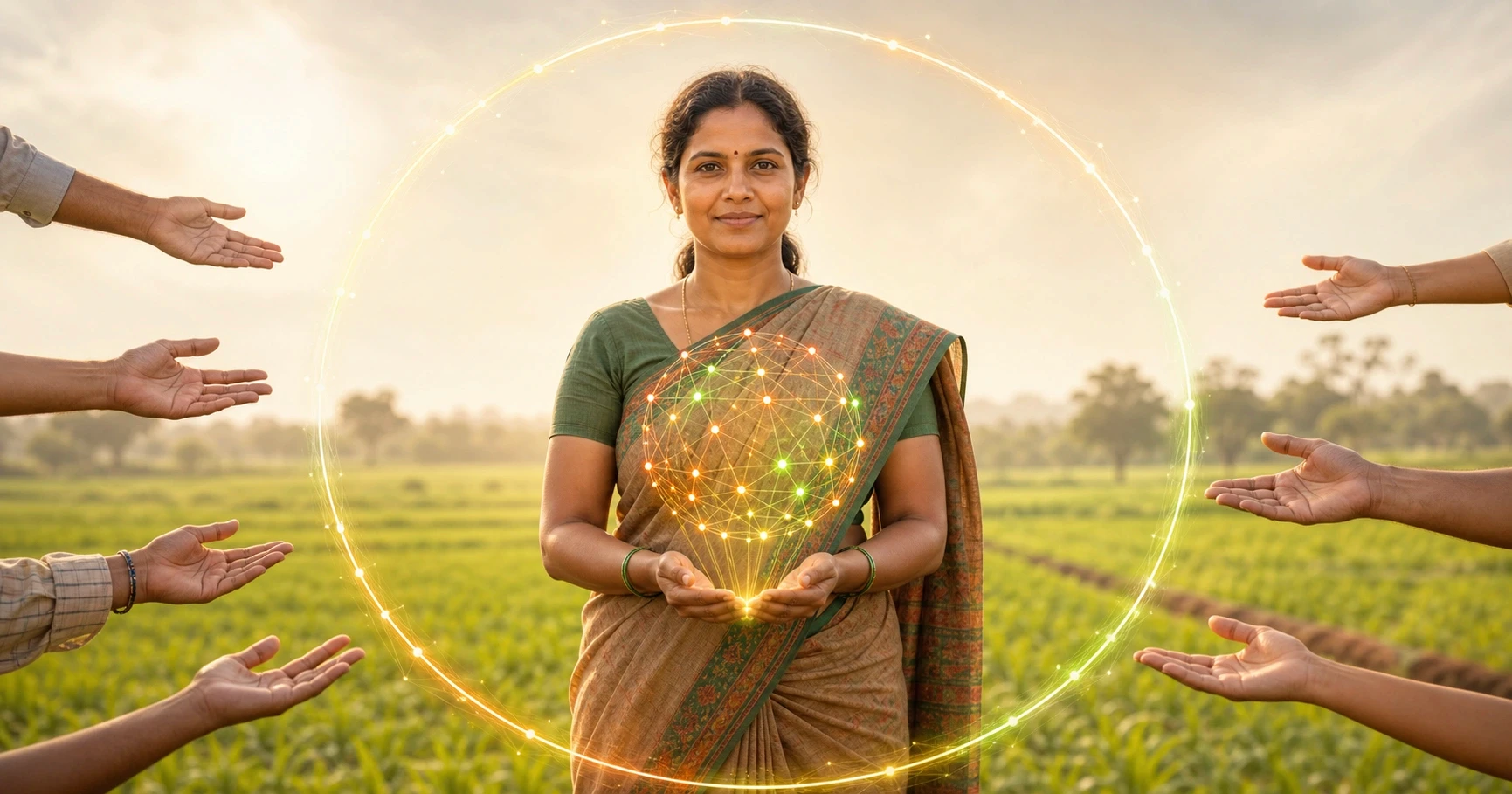
Across our field visits, we often meet farmers who carry their entire relationship with the state in a single, carefully kept folder — Aadhaar copies, land records, applications in progress. That folder is a testament to their diligence, and a gentle question to everyone who builds for Bharat: with the foundations Digital India has laid, can we not offer something worthier of that diligence? This article is about the answer those foundations have made possible.
Consider a smallholder farmer in Madhya Pradesh preparing for the kharif season. To claim what the nation has already promised her, she must navigate a dozen disconnected systems: one portal to check PM-KISAN status, another to verify her land record, a bank branch for a Kisan Credit Card, an agent for PMFBY crop insurance, a mandi or eNAM registration for sale, and a patchwork of intermediaries to stitch it all together. Each of these exists. Many work well on their own. And yet the annadata — the woman who feeds the nation, and one of the least-resourced actors in the entire chain — is left holding the hardest job of all: she has to be the integrator.
This is the quiet failure at the centre of Indian agriculture. Not a lack of services, but a lack of coordination between them. And it is a failure another app cannot fix — because more apps are what created it.
The app era solved the wrong problem
Over the past decade, Indian agriculture drew a wave of well-intentioned digital effort: advisory apps, marketplace apps, credit apps, weather apps, input-commerce apps. Each addressed a real gap. Together they produced something no one designed on purpose — a landscape in which every service is a silo, each demanding its own onboarding, its own data, its own trust, and none of them talking to one another.
The logic of the app is additive. It assumes the way to help the farmer is to hand her one more tool. But her core problem is not that she lacks tools; it is that she lacks a way to move through them coherently. A thirteenth app on a stack of twelve does not reduce her burden — it adds a new point of friction, a new place to abandon the journey, a new opening for an intermediary to take a margin.
The cost shows up in the gap between entitlement and outcome. Schemes are announced but under-claimed. Credit is sanctioned in aggregate but does not always reach the creditworthy individual — studies suggest that roughly a third of agricultural borrowing still flows through informal, high-cost lenders, despite decades of well-designed policy support. Markets exist but returns leak away before they arrive. That distance is not a distribution problem to be solved with more distribution. It is an integration problem — and integration is not something you download.
What an operating system actually does
An operating system does not replace applications; it coordinates them. When you use a laptop, you do not manage memory or wire transistors — the OS abstracts that away and gives you one coherent surface through which everything else becomes usable.
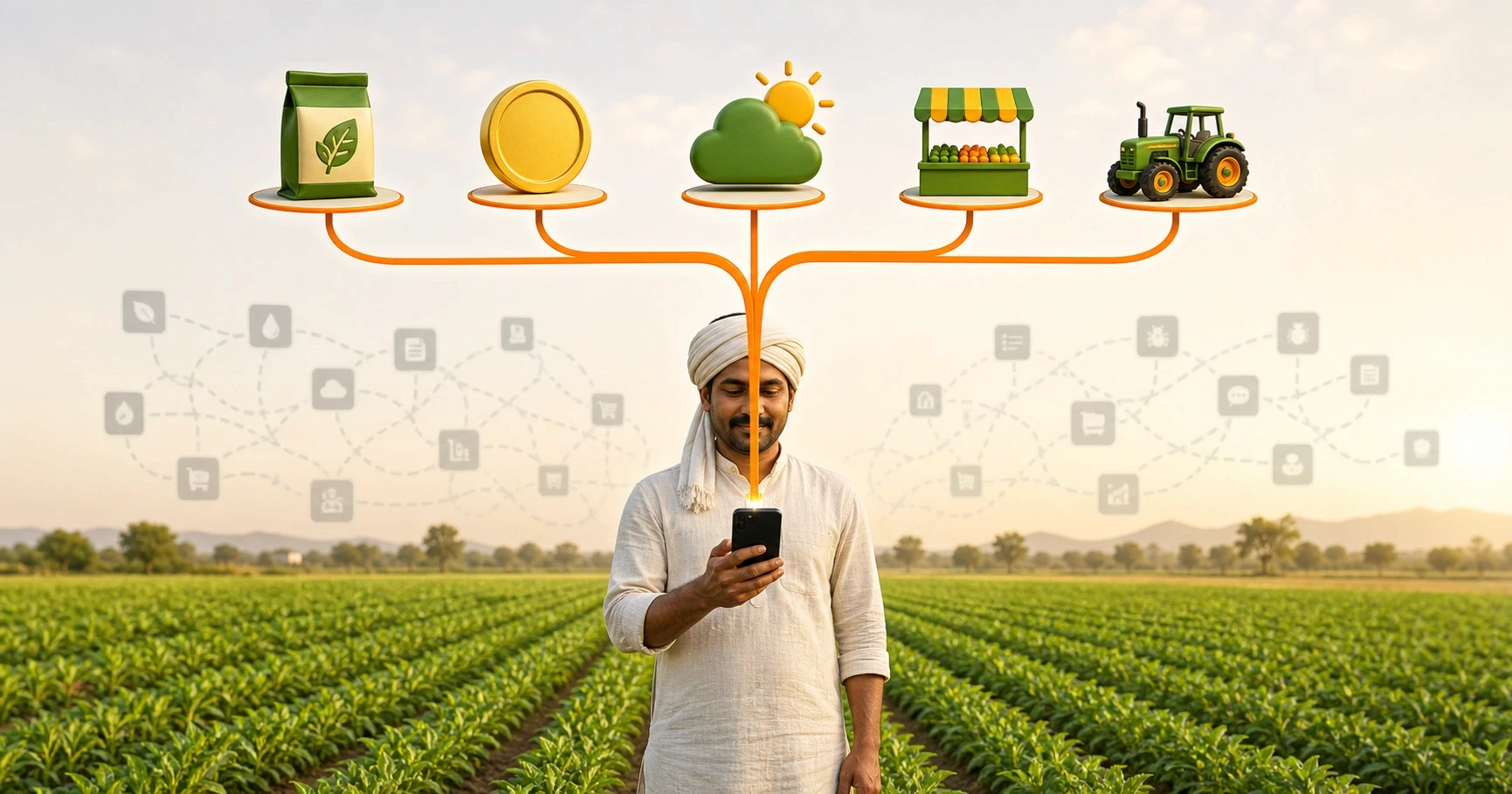
Translate that to the farm. A farmer operating system does not out-compete every scheme portal, lender, insurer, and marketplace. It sits above them and renders the fragmented universe of public and private services as a single journey — discover, decide, document, apply, transact, track — in the farmer’s own language, through one trusted path. The complexity does not vanish. It moves off the farmer’s shoulders and into the system, where it belongs.
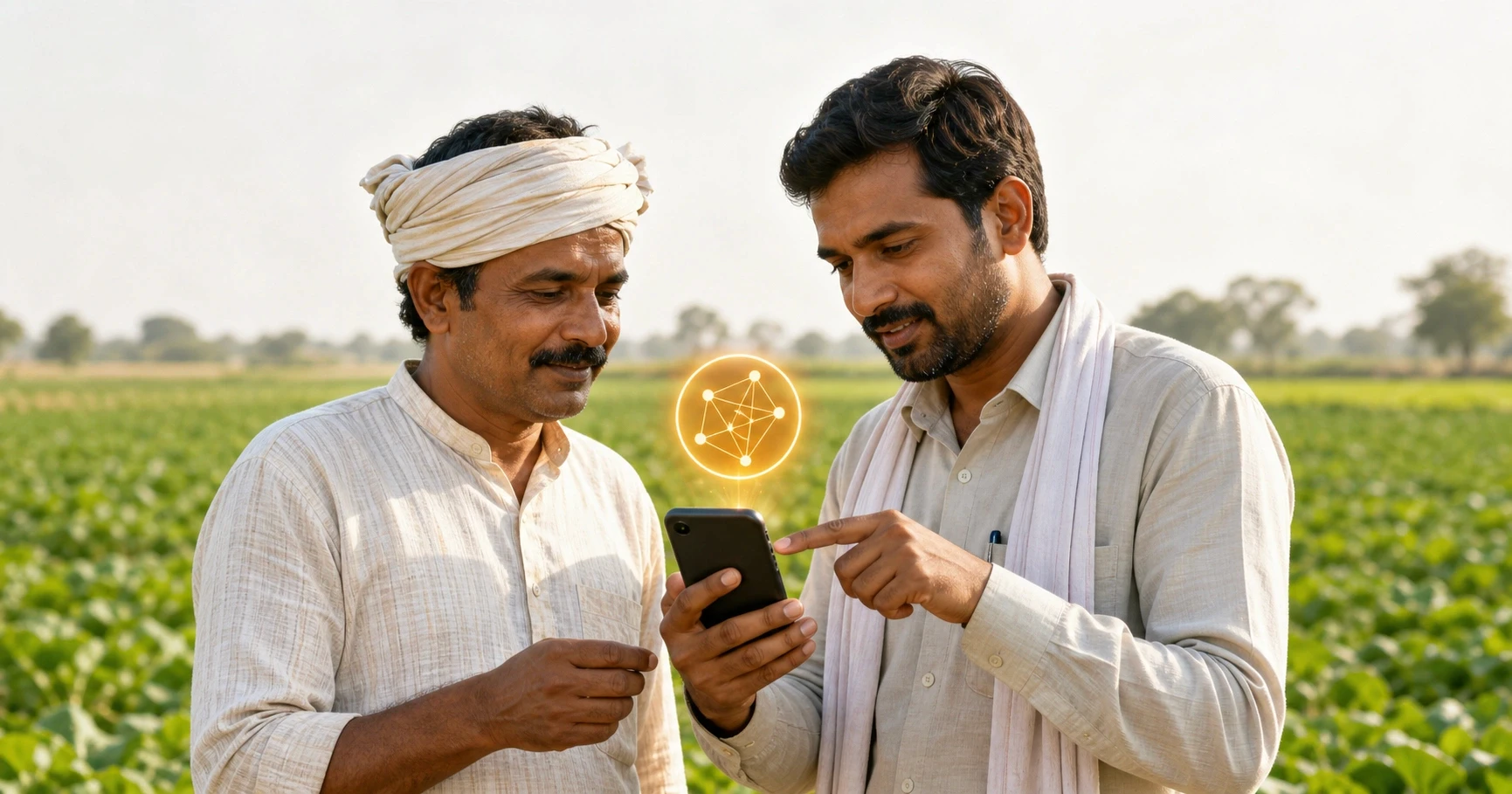
In practice, that journey looks like this. The farmer is onboarded once, with her consent, against her verified AgriStack record. The system tells her, in Hindi or her own boli: you are eligible for PM-KISAN instalments you have not received; your landholding qualifies you for a KCC limit; your crop and district make PMFBY enrolment worthwhile before the cut-off date; the mandi price for soybean is trending here. It then prepares the documentation, files the applications, executes the transactions, and shows her the status of each — one screen, one path, one accountable record.
This is the distinction Gramraj is built on, and it is one of architecture, not branding. Four layers: a farmer experience layer that presents one vernacular journey; an intelligence layer that matches each farmer to entitlements, credit, and advice with a human in the loop; an integration layer that connects securely to government, finance, markets, and verified AgTech services; and a trust and governance layer that keeps farmer data consented, owned, and auditable at every step.
The real failure is asking the farmer to be the integrator
Every fragmented system has an integrator — someone has to make the pieces fit. In Indian agriculture, that role has defaulted to the two actors least suited to it: the farmer herself, and the middleman who profits from her not having a better option.
When the farmer is the integrator, value leaks at every seam. When the middleman is, the seam becomes a toll booth. Either way, the cost of coordination is paid by the person who can least afford it. An operating system reassigns that role — making coordination a property of the infrastructure rather than a burden on the individual. The value an OS creates is exactly the coordination cost it removes, and in a sector this fragmented, that cost is enormous.
Why this is possible now — and wasn’t five years ago
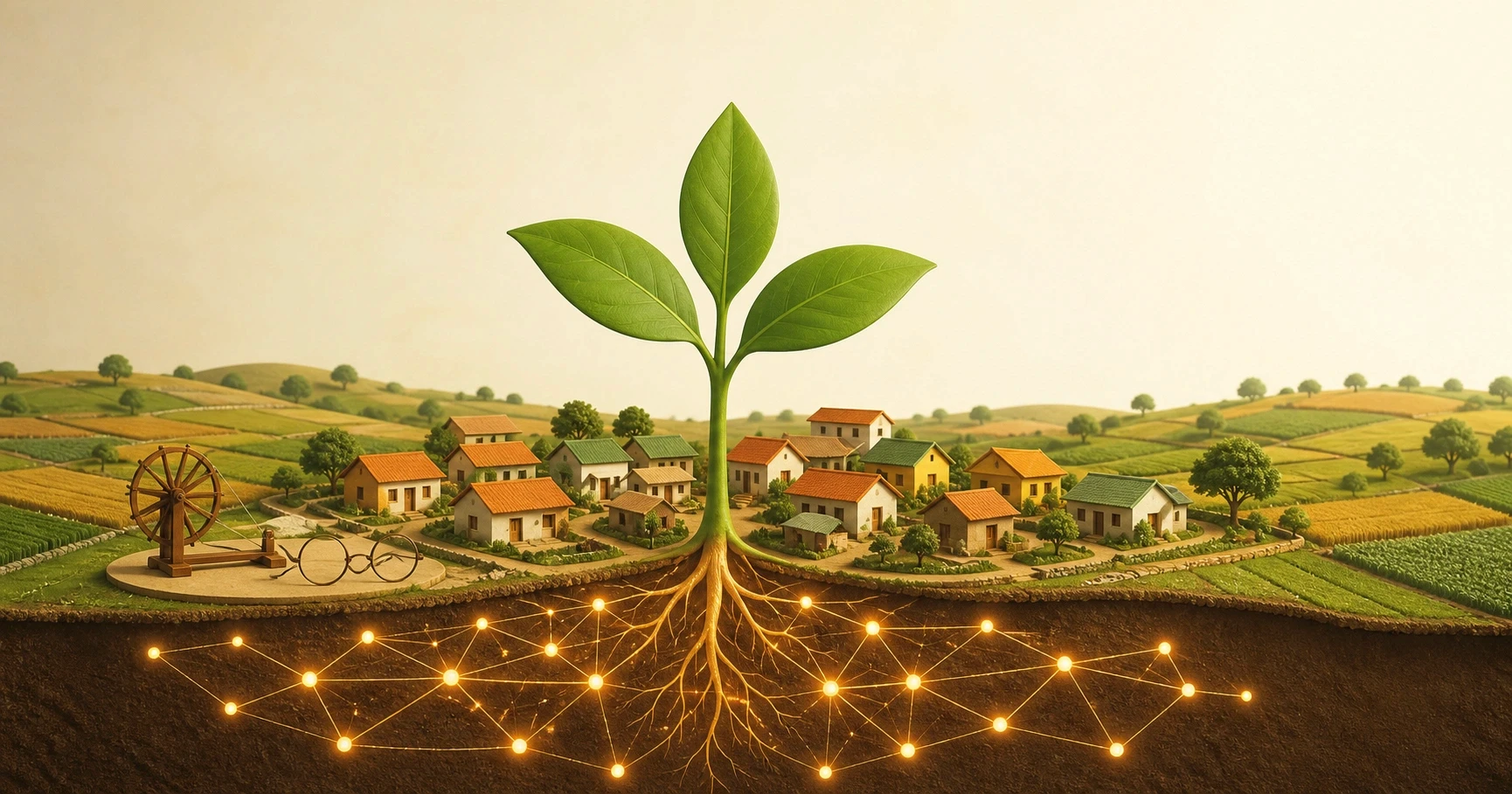
For most of the last decade, an operating system for the farmer would have been an idea ahead of its rails. That is no longer true, and the reason is India’s own achievement. In the years since Digital India began, the nation built the substrate that makes coordination possible: Aadhaar for identity, UPI for real-time payments at a scale no other country matches, consent-based data-sharing frameworks, and now AgriStack — a farmer registry designed around consent-based access to verified farmer, land, and crop data. These are the rails, built in India, by India. What has been missing is the operating layer that turns rails into services a farmer can actually use.
UPI shows the pattern. It did not win because it was a better payment app; it won because it was an interoperable public layer on which a thousand applications could run. Payments stopped being walled gardens and became a national utility. Agriculture is now at the same inflection point — and a layer, by definition, is something no single app can occupy.
Trust is the kernel, not a feature
In agriculture, data is not exhaust. A farmer’s landholdings, credit history, crop patterns, and geolocation are among the most sensitive and strategically valuable datasets the nation holds. An operating system that coordinates services inevitably sits on top of that data — so who owns it, who can access it, under what consent, and under whose jurisdiction is not a side issue. It is the kernel.
Gramraj is architected so farmer data is owned by the farmer, shared only through explicit and revocable consent, recorded on an auditable consent ledger, and governed within India’s own legal framework — the Digital Personal Data Protection Act, 2023 and the AgriStack consent architecture. That is what makes the model fundable rather than merely functional. A bank cannot lend against data whose provenance it cannot trust. A government cannot deliver benefits through a channel it cannot audit. Trust, built into the architecture, is what turns a farmer-facing product into institutional-grade national infrastructure.
The category, and the stakes
India will not digitise agriculture one app at a time; the last decade proved that. The next phase belongs to infrastructure — the operating layer that makes the existing universe of schemes, credit, markets, and services finally cohere into something a farmer can navigate and an institution can rely on.
That layer must be built for Bharat first: vernacular, human-in-the-loop, consent-first, and respectful of the trust placed in it. The farmer does not need another app. She needs an operating system — and thanks to the digital foundations the government has patiently laid over the past decade, it can now, at last, be built for her.