One Onboarding, Many Services: Ending AgTech Fragmentation for the Indian Farmer
India has thousands of AgTech solutions and a farmer who cannot use them together. The missing piece is not another solution. It is interoperability — the principle that made UPI a national triumph, applied to the farm.
By Devika Menon · Contributing Writer, Technology & Rural Development
The vibrancy of Indian AgTech is something to celebrate — hundreds of homegrown ventures, each a small act of Atmanirbhar enterprise, attacking every link of the agricultural value chain. The opportunity now is to give that creative energy what UPI gave the fintech ecosystem: a common layer through which it all reaches the citizen as one coherent experience. This article is about that layer.
The Indian AgTech sector is, by one measure, a success: a large and inventive ecosystem of homegrown companies attacking every part of the agricultural value chain — proof of what Indian entrepreneurship can build. By another measure, it is a frustration, because from the farmer’s point of view all that invention arrives as a pile of disconnected tools she cannot combine. The problem is no longer a shortage of solutions. It is that the solutions do not interoperate — and fragmentation, past a certain point, is its own failure mode.
The fragmentation tax
Every additional standalone solution imposes a small tax. It asks the farmer to onboard again, share her data again, learn another interface, extend trust again from zero. Each tool solves one problem while adding to the meta-problem of a landscape too fragmented to navigate. For the farmer, the marginal advisory or marketplace app is not a net gain if it cannot connect to the credit, the scheme, and the data she has already provided elsewhere.
For the AgTechs themselves, fragmentation is also costly. Each spends heavily to acquire the same farmers, verify the same identities, and build the same trust — duplicated effort the sector collectively pays for, many times over. Indian innovation is being taxed by Indian fragmentation.
Why point solutions plateau
A point solution, however excellent, is bounded by its own edges. An advisory tool cannot complete the loop to credit; a marketplace cannot verify entitlements; a credit product cannot prepare the documentation that precedes it. Each hits a ceiling defined by everything it does not control. This is why the sector plateaus in impact even as it grows in count: adding more point solutions increases the number of ceilings without removing any of them. The farmer’s journey still breaks at every silo boundary.
The interoperable layer — how it works in practice
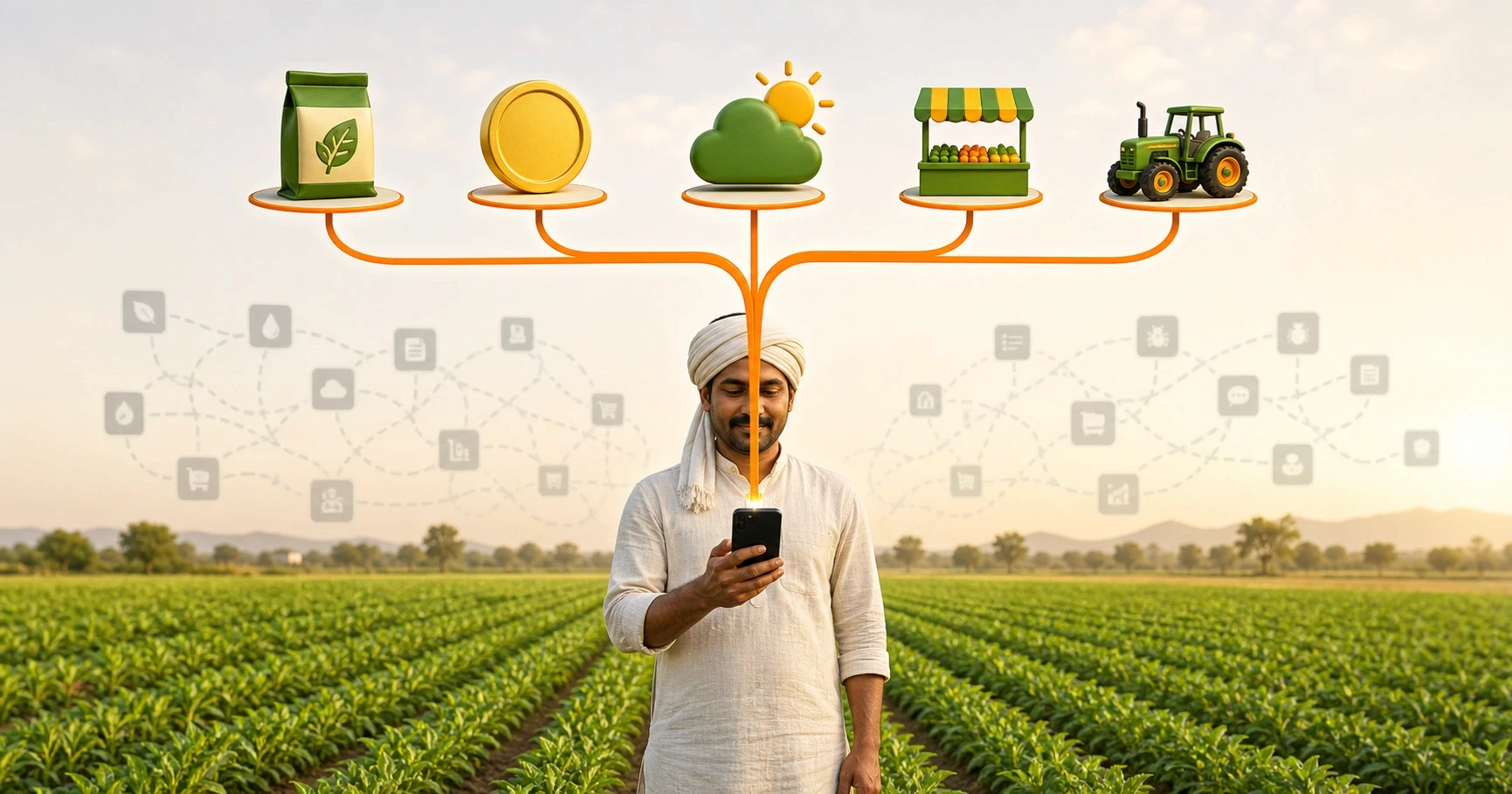
The alternative is a layer that lets these solutions work together. The farmer onboards once, against her verified AgriStack identity, with her consent recorded. Her data then travels with her — under consent, purpose-limited, logged — across every participating service. A soil-testing service plugs in and receives her plot details the moment she approves; its results flow, with her consent, to the advisory engine; the advisory’s crop plan informs the credit assessment; the credit feeds input purchase; the harvest connects to buyers. One journey, many specialists, zero repeated onboarding.
Interoperability changes the competitive logic from enclosure to contribution. Solutions no longer win by trapping farmers inside a silo; they win by being the best service available within a shared journey. The layer coordinates; the participants specialise — exactly the ecosystem logic that let hundreds of UPI apps flourish on one national rail.
What partners gain
For an AgTech, plugging into an interoperable layer is not a loss of independence; it is access to distribution and trust it would otherwise have to build alone. Instead of spending to acquire and verify farmers one by one, it reaches farmers who are already onboarded and already trust the layer. Instead of being one more icon on an overwhelmed farmer’s phone, it becomes a service delivered at the right moment in a journey she is already completing.
Gramraj is designed to be that interoperable layer — the connective tissue that turns a fragmented sector into a functioning national ecosystem. The prize is not to replace India’s AgTechs. It is to make them, collectively, finally usable by the farmer they were all built to serve.