The Economics of Trust: Why Serving the Kisan Honestly Is Also the Best Business

Trust reads as a soft value until you model it. In an operating system for the farmer, it is the variable that compounds — and compounding is what makes the economics work.
By Meera Sanghvi · Contributing Writer, Business & Economics
Accountants are trained to respect what can be measured, and to be politely sceptical of words that never appear on a balance sheet. “Trust” is usually such a word. In this business, it is not. This article shows where trust appears in the model, how it compounds, and why the honest way to serve the farmer is also the enduring way to build the enterprise.
Investors are right to be sceptical of “trust” as a pitch word; it is easy to claim and hard to measure. But in the specific case of a farmer operating system, trust is not a virtue bolted onto the business. It is the mechanism through which the unit economics actually work. Understand how trust compounds, and the reason an operating layer is a business rather than a subsidy becomes clear — as does the reason the honest model beats the extractive one on its own terms.
Why acquisition is not the game
Much of consumer technology is a race to acquire users cheaply and monetise them fast. In rural India, that logic breaks. Acquisition is expensive, trust is slow to build, and a farmer served badly once is lost — and tells her village. Word of mouth is the true medium of rural Bharat, and it punishes extraction faster than any regulator. A model that depends on constant, costly acquisition of low-trust users, monetised aggressively, does not compound; it churns.
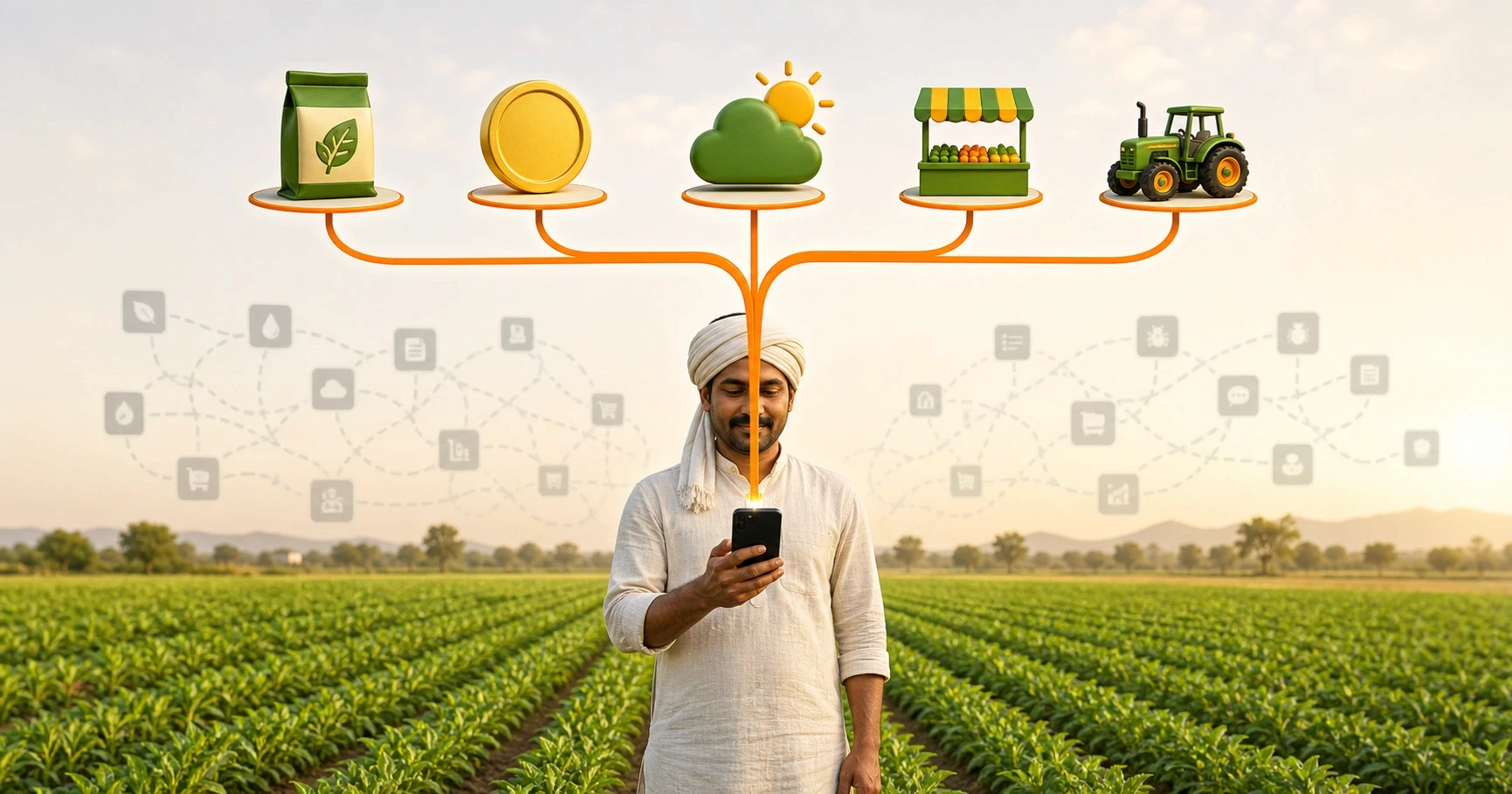
The operating-system model plays a different game. Its value is not in acquiring the most farmers but in becoming the trusted layer through which each farmer conducts an expanding range of activity over time — this season a scheme claim, next season a KCC, then insurance, then market linkage, then the same for her self-help group. The economics are driven by depth, retention, and the compounding of trust into more usage and better data.
The trust flywheel
The core mechanism is a flywheel. A farmer who trusts the system shares more and more accurate data. Better data makes the intelligence sharper — better matches, better credit assessments, better advice. Sharper intelligence produces better outcomes. Better outcomes deepen trust — and travel by word of mouth to the next farmer, cutting acquisition cost with every turn. Each cycle lowers the cost of serving the farmer and raises the value delivered.
This is why trust is an economic variable, not a moral garnish. It is the input that makes every subsequent interaction cheaper and more valuable than the last. And it is self-reinforcing: the system that earns trust earliest pulls ahead in a way that is hard to catch.
Outcome-orientation versus engagement
There is a crucial design choice embedded here. Much of technology optimises for engagement — time spent, sessions, attention. An operating system for the farmer must optimise for outcomes — schemes claimed, credit received, sales completed, rupees landed in the account. A farmer does not want to spend time in an app; she wants a result and her day back in the field. A system that measures itself by outcomes aligns its success with the farmer’s — which is precisely what builds the trust the flywheel runs on. Outcome-orientation is not just ethically preferable; it is the only metric that compounds.
Why the economics compound — and why trust is defensible
Put the pieces together. Trust lowers acquisition and service costs over time. Depth of usage raises value per farmer without proportional new spend. Better data improves the core product for everyone at once. Outcome-orientation keeps churn low and word-of-mouth positive. Costs bend down as value bends up — the signature of a business that compounds rather than merely scales.
And trust is defensible in a way features are not. A competitor can copy an interface overnight. It cannot copy a trusted relationship with millions of farmers, or the years of consented data and proven outcomes that produced it — and it certainly cannot copy it while running a model that monetises the farmer’s data against her interest.
This is the investment case beneath the mission, and it carries a distinctly Indian conclusion: in serving the annadata, doing right by the farmer and building enduring value are the same strategy. Gramraj is built as the trusted, outcome-oriented operating layer for the Indian farmer because it is the right thing to build — and because it is the version of this business whose economics compound. Seva and scale, it turns out, point the same way.